
Tazewell Projected Versus Actual Release
A projected release date is a forward calculation. It reflects the sentence information, credit rules, and custody data available when the calculation is made. It can move. An actual release is a completed custody event supported by a dated jail record, a VADOC status change, or signed release papers. A court order can authorize release without proving that staff completed the physical exit at that same time.
Three stages should remain separate. First comes the calculated date. Next comes legal or administrative authority to act. Last comes the release event itself. For a Pocahontas State Correctional Center prisoner, VADOC Operating Procedure 010.3 calls the forward value the projected release date. For a person serving a local term at the SWVRJA Tazewell Adult Detention Center, the local authority may be the calculator. SWVRJA's actual date, time, disposition, and destination are the better retrospective record.
A pretrial detainee has no sentence-based projected date. Bond may be ordered but not posted. Another warrant or detainer may also prevent community return. Use the court docket to understand the legal action, then use SWVRJA to confirm what happened at the jail.
Note: A court-authorized bond does not supply a sentence-based projected date or prove that jail staff completed the release.
Who Computes Tazewell Release Dates
Responsibility follows the sentence and the amount of active time, not just the building where a person sleeps. VADOC calculates an Earned Sentence Credit release date when active ESC time exceeds 12 months. Local authorities may calculate shorter or local-responsible terms. A person can be physically housed in a regional jail while VADOC has calculation responsibility, so the custodian and legal authority must both be identified.
| Custody setting | Date source | Best completed-release proof |
|---|---|---|
| SWVRJA local-responsible sentence | SWVRJA or responsible local authority | Existing jail release event with date, time, reason, and destination |
| VADOC-responsible term | VADOC time computation and locator | Dated release letter or signed Order of Release and status change |
| Pretrial detention | No sentence-based date; court and bond events control | Court authority plus SWVRJA confirmation |
| Eligible parole case | Board decision followed by VADOC execution | VADOC community status or signed Conditions of Parole |
Ask whether the person is local-responsible or VADOC-responsible before requesting a calculation. That single distinction prevents a common error: sending a short SWVRJA term to VADOC or treating a VADOC term as a county-jail computation.
Physical location alone cannot settle the issue. The VADOC locator covers state institutions, district offices, institutional hospitals, CCAP placements, and some local or regional jail residents under state authority. A person shown at a regional jail may therefore have a state-computed term. Ask the listed custodian which sentence authority controls, then cite the DOC number and final order when requesting a current date.
Find a Tazewell Projected Release Date
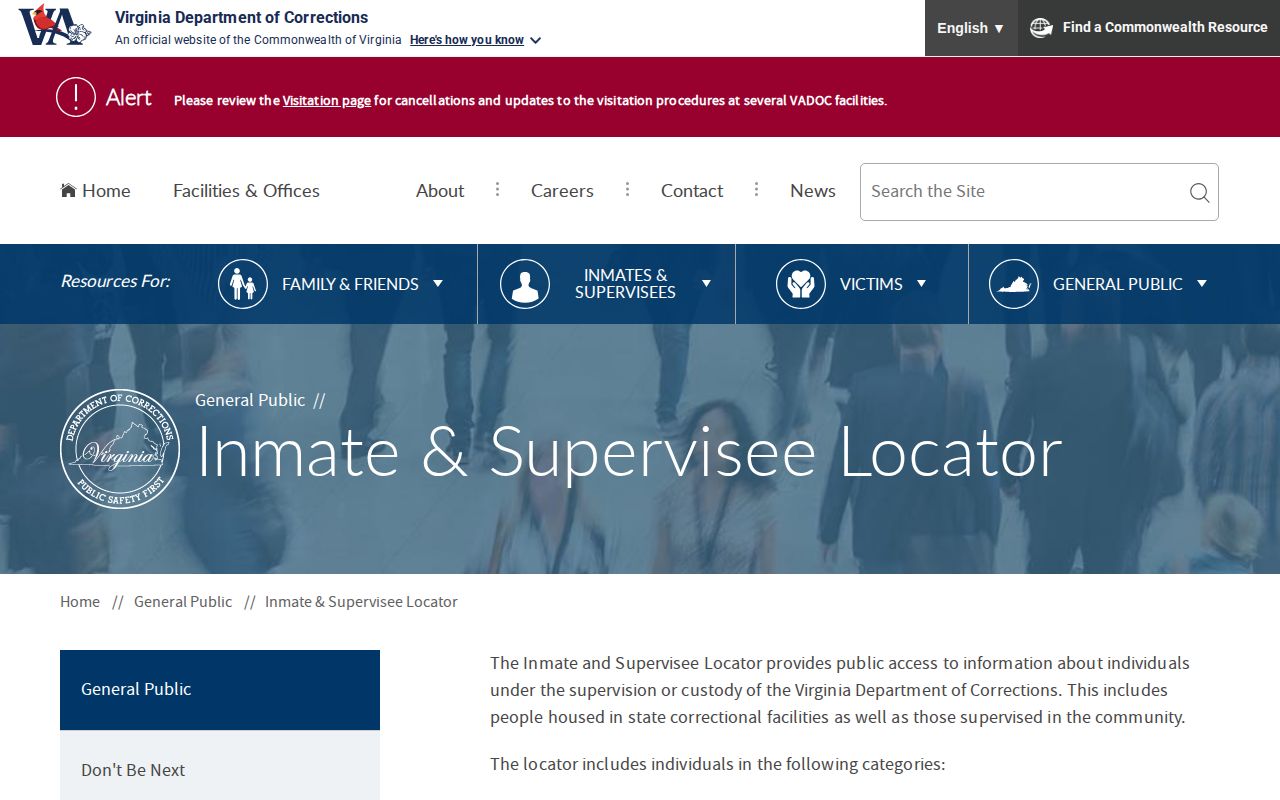
Use the known facility and sentence type to choose the first channel. The VADOC locator is appropriate for a state prisoner or another person under VADOC authority. It accepts a seven-digit DOC number or at least the first three letters of a first name with the full last name. Optional filters include location, race, gender, and age range. VADOC states that the locator is updated daily but may be inaccurate or outdated.
- Confirm whether the person is at SWVRJA Tazewell, Pocahontas State Correctional Center, another VADOC site, or a district office.
- For VADOC authority, search the Inmate and Supervisee Locator and compare the identifiers carefully.
- Record the exact release-date label, displayed date, status, location, and the date the result was checked. Call a future value projected unless the source expressly says otherwise.
- For a local sentence, contact SWVRJA and ask which authority calculated the term. Use the Tazewell court order to confirm active and suspended portions.
- For an individualized state calculation, contact the VADOC Correspondence Unit/Court & Legal Section rather than doing independent sentence math.
- After the listed day, obtain the actual jail event or signed state release paper.
The official locator presents the search fields and warns users about update limits.
A no-result is inconclusive. It can mean a local-only term, a spelling issue, a data delay, or complete discharge from VADOC authority. The broader Tazewell County released-inmate search explains how jail, court, state, and federal records fit together.
Tazewell Release Credits: GCA and ESC
Virginia uses more than one credit system. Good Conduct Allowance, or GCA, generally applies to felony offenses committed before January 1, 1995 and misdemeanor offenses before July 1, 2008. VADOC calculates parole eligibility, mandatory parole, and good-time dates when active parole-eligible GCA terms total more than 12 months. Depending on class level, the state source describes a range from no credit to 30 days per 30 days served. Virginia Code § 53.1-198 and § 53.1-202 govern that framework.
Earned Sentence Credits, or ESC, generally apply to felony offenses committed on or after January 1, 1995. One earned credit deducts one day. Sections 53.1-202.2 and 53.1-202.3 govern eligibility and rates. VADOC calls restricted-rate terms ESC-1, with a possible range from zero to 4.5 days per 30 days served. Statutorily eligible ESC-2 terms may earn from zero to 15 days per 30 days, depending on eligibility and classification.
The VADOC time-computation page identifies the GCA and ESC systems and explains which authority performs the work.
The applicable system depends on facts such as offense date and sentence structure. The page cannot replace the current official computation for one person.
Classification also matters. Credit is earned under the rate and legal eligibility that apply to the term, and later program or conduct records can alter the amount posted. GCA, ESC-1, and ESC-2 are not labels that can be chosen from the sentence length alone. The current VADOC computation should identify the governing credit track and applied time.
Why Tazewell Release Dates Change
A projected date can move because the inputs or legal status change. Some changes add credit, while others remove it or create a new barrier to release. The current computation should be obtained after any new court order, disciplinary decision, or custody hold.
| Factor | Possible effect on the projected date | Record to check |
|---|---|---|
| Pre-sentence jail credit | Credits qualifying time already spent in custody | Sentencing order and computation |
| Concurrent or consecutive terms | Changes how multiple sentences combine | Final orders and VADOC calculation |
| Credit class and programs | Changes the credit earning rate where legally eligible | Current GCA or ESC computation |
| Discipline or restored credit | Can forfeit or restore time credit | VADOC record and § 53.1-189 |
| Later court order | Can amend active or suspended time | Dated court order |
| Warrant or detainer | May prevent community release or change the receiving custodian | Hold check and release disposition |
| Parole Board action | A Grant starts a VADOC date-setting step; it does not cause instant release | Board report, VADOC status, release papers |
Virginia Code § 53.1-189 addresses forfeiture. Active and suspended time, offense subsection, participation, administrative correction, and a new detainer can also change the result. The listed date must be treated as a snapshot.
Multiple orders require special care. A concurrent sentence may run at the same time as another term, while a consecutive term follows it. Pre-sentence credit must be assigned to the correct case. A suspended portion is not the same as active confinement, though later revocation can place some of that time back into issue. These are reasons to obtain the agency calculation and court orders, not to work backward from a docket's total sentence.
Note: Keep the check date with every projection because later credits, orders, discipline, warrants, or detainers can change the displayed value.
Tazewell Parole Grant Date Limits
Parole eligibility, a Board Grant, and physical release are three different points. Under current § 53.1-136, VADOC sets and executes the date after receiving Board notice. The timing rule generally places release at least 30 business days after notification, except for specified conditional-release circumstances. Until VADOC shows community supervision or signed release papers document the event, the accurate statement is “parole granted; release not yet confirmed.”
Eligibility is not a promise. Section 53.1-151 contains distinct rules for eligible first, second, third, and later commitments, while § 53.1-165.1 generally ends ordinary parole for post-1994 felonies with defined exceptions. Only the actual term and record determine which framework applies.
A monthly Parole Board PDF can establish the exact decision and certification dates, reasons, and votes. If it says Grant, record that term without rewriting it as “released.” Search VADOC after the decision. An institution location shows continuing custody; a probation or parole district may support community supervision after execution. Signed Conditions of Parole provide the dated legal record.
Confirm Tazewell Actual Release
VADOC's state release process supplies the retrospective proof. The person receives a notification-of-release letter and reads or is read the applicable Order of Release, Conditions of Probation, or Conditions of Parole. The person and a witness sign and date the papers. VADOC says discharge or parole release occurs by 11:59 p.m. on the release date, weather permitting.
The VADOC facility-release page shows that release-day process and its signed documents.
For a local SWVRJA sentence, request the existing event with actual date, time, disposition, authority, and receiving custodian if releasable. A VINE alert can provide timely notice but may describe a transfer. The Tazewell County VINELink Check explains how to register and read the event type without mistaking a custody handoff for community release.
For a historical state release, request the existing notification letter, signed release order, and actual release type rather than asking VADOC to create a new calculation. For SWVRJA, provide the booked name, date of birth or booking number if known, and approximate custody dates. A narrow request is more likely to locate the event that distinguishes release to the community from transfer to another authority.
Keep the date checked with every result. If the projected date changes, preserve both official snapshots and obtain the new computation. That makes the change traceable without guessing whether credit, a court order, or a hold caused it. Once release occurs, replace forecast wording with the exact language from the completed event.
Note: Replace projected wording only after an affirmative jail event, VADOC status change, or signed release document confirms completion.